How to Disassemble an Asus Zenbook Q415MA: Step-by-Step RAM & SSD Replacement
Pre-Disassembly Preparation & Tools Required Safe Shutdown & Workspace Setup Bottom Cover Removal & Internal Access Battery Disconnection & Power Safety RAM Upgrade: Installation & Compatibility Guide SSD Replacement: M.2 Drive Installation Professional Reassembly & System Testing Performance Optimization & Data Migration Troubleshooting Common Installation Issues Maximizing Resale Value After Upgrades
1. Asus Zenbook Q415MA Pre-Disassembly Preparation & Tools Required
💾 Recommended Upgrade Components
RAM Compatibility :
DDR4 2400MHz SODIMM (8GB or 16GB maximum)
Single channel configuration
Check Crucial Compatibility Tool
Recommended: Crucial CT8G4SFS824A 8GB DDR4
SSD Compatibility :
M.2 2280 SATA or NVMe SSD
Up to 1TB capacity supported
Recommended: Samsung 970 EVO Plus 500GB
Budget option: Crucial P2 500GB NVMe
⚠️ Safety Equipment & Workspace Setup
Personal Protection :
Anti-static wrist strap properly grounded
Safety glasses for component handling
Well-ventilated workspace
Clean, dry hands free of oils and lotions
Workspace Requirements :
Clean, flat surface with ample working space
ESD-safe mat or wooden table surface
Adequate lighting for intricate work
Organized containers for different screw types
📋 Pre-Disassembly Checklist
Data Backup :
Backup important files to external drive or cloud
Create system restore point
Export browser bookmarks and passwords
Document software licenses and product keys
System Documentation :
Record current specifications using CPU-Z
Check storage health with CrystalDiskInfo
Photograph laptop condition from all angles
Note model number and serial number
Workspace Preparation :
Clear large, clean work area
Organize tools within easy reach
Set up ESD protection equipment
Prepare magnetic mat with labeled sections
💡 Budget-Friendly Tool Alternatives
Basic Toolkit Under $25 :
Generic precision screwdriver set from hardware store
Old credit cards cut into plastic spudgers
Ice cube tray for screw organization
Hairdryer for warming adhesive if needed
ESD Protection on Budget :
Work on non-carpeted, non-static surface
Touch grounded metal before handling components
Use original anti-static bags for part storage
Avoid working in dry, static-prone environments
⏱️ Project Time Estimates
First-Time Disassembly :
Total time: 45-60 minutes
Preparation: 10 minutes
Disassembly: 20-30 minutes
Reassembly: 15-20 minutes
Experienced Users :
Total time: 25-35 minutes
Preparation: 5 minutes
Disassembly: 10-15 minutes
Reassembly: 10-15 minutes
❌ Common Preparation Mistakes to Avoid
Rushing the Process :
Symptom: Damaged clips or stripped screws
Cause: Insufficient time allocation
Prevention: Allow adequate time and work methodically
Poor Organization :
Symptom: Lost screws or mixed components
Cause: Inadequate workspace setup
Prevention: Use magnetic mat and labeled containers
ESD Neglect :
Symptom: Intermittent component failures
Cause: Working without proper ESD protection
Prevention: Always use anti-static wrist strap
💰 Resale Value Impact
Professional Preparation Benefits :
Proper ESD protection: +$20-30 value
Clean workspace practices: +$15-25 value
Documented procedures: +$10-20 value
No damage from poor preparation: +$40-60 value
Buyer Confidence Factors :
Demonstrates careful approach to device maintenance
Indicates professional handling of components
Suggests longer device lifespan and reliability
Supports higher asking price for quality workmanship
🛠️ Pro Tip: Asus Zenbook Q415MA models with documented professional upgrades and proper preparation procedures sell 40% faster to knowledgeable buyers. The absence of tool marks and professional approach can justify 25-35% price premiums, as buyers recognize and value proper handling techniques for premium ultrabook components.
2. Asus Zenbook Q415MA Safe Shutdown & Workspace Setup
🔄 Professional Ultrabook Shutdown Sequence
Application & Data Protection :
Close all applications and save open documents
Stop any active file transfers or downloads
Ensure no background updates are in progress
Backup important data before beginning disassembly
Windows Shutdown Process :
Use Start Menu → Power → Shutdown (not restart)
Wait for complete power down (all lights off)
Do not force shutdown unless absolutely necessary
Allow system to complete all shutdown processes
Physical Disconnection :
Disconnect 65W power adapter from laptop
Remove all USB devices and peripherals
Disconnect external monitors if attached
Remove headphones and other audio devices
⚡ Complete Power Discharge Procedure
Residual Power Drain :
Hold power button for 15-20 seconds after shutdown
This discharges capacitors in the power circuit
Wait for any status lights to turn off completely
Confirm complete power loss before disassembly
Battery Safety Check :
Visually inspect battery for swelling or damage
Check for unusual smells, heat, or discoloration
Ensure battery connector is secure and undamaged
Note any pre-existing power or charging issues
🛠️ Professional Workspace Setup
Workspace Element
Requirements
Zenbook Specifics
Safety Importance
Work Surface
Clean, flat, ESD-safe surface
Large enough for 14" chassis and components
High - Prevents slips and ESD damage
Lighting
Bright, even illumination
LED desk lamp for small component visibility
High - Prevents mistakes and damage
ESD Protection
Anti-static mat and wrist strap
Critical for RAM and SSD protection
Critical - Protects sensitive components
Organization
Magnetic mats, containers
Separate areas for different screw types
Medium - Prevents lost parts
⚠️ ESD Protection for Ultrabook Components
Personal ESD Protection :
Wear anti-static wrist strap
Connect to grounded metal or ESD mat clip
Test wrist strap continuity if possible
Wear throughout entire disassembly process
Workspace ESD Setup :
Use ESD-safe mat covering entire work surface
Keep all components on ESD-safe surfaces
Avoid working on plastic or carpeted surfaces
Maintain proper humidity (40-60% ideal)
Component Handling :
Handle components by edges only
Avoid touching gold contacts and connectors
Use anti-static bags for component storage
Keep components away from synthetic materials
📋 Professional Workspace Organization
Screw Management System :
Use magnetic project mat with labeled sections
Organize screws by type, location, and size
Take photos of screw arrangements before removal
Keep small containers for different screw sizes
Component Layout :
Designate specific areas for different components
Keep delicate components (RAM, SSD) in safe locations
Organize tools within easy reach but out of harm's way
Maintain clear walking paths around workspace
🔍 Pre-Disassembly Safety Checks
Physical Inspection :
Check for liquid damage, corrosion, or moisture
Inspect for swollen battery or damaged ports
Look for cracked or damaged chassis components
Note any pre-existing issues for documentation
Environmental Safety :
Ensure adequate ventilation in workspace
Keep food and drinks away from work area
Maintain clear emergency access paths
Have fire extinguisher accessible if possible
💻 Zenbook Q415MA Specific Considerations
Ultrabook Design Features :
Thin chassis requires careful handling
Small screws and delicate clips
Compact internal layout
Premium materials that scratch easily
Component Sensitivity :
RAM and SSD are highly ESD-sensitive
Small connectors require careful handling
Battery connector has secure locking mechanism
Multiple ribbon cables with delicate connectors
❌ Common Shutdown & Setup Mistakes
Rushed Shutdown :
Symptom: Data corruption or system instability
Cause: Force shutdown during updates
Prevention: Proper shutdown sequence and patience
Poor ESD Practices :
Symptom: Intermittent component failures
Cause: Working on non-ESD safe surfaces
Prevention: Proper ESD protection and workspace
Disorganization :
Symptom: Lost screws or mixed components
Cause: Poor workspace organization
Prevention: Systematic organization before starting
📊 Professional Setup Documentation
Pre-Service Photos :
Photograph laptop condition from all angles
Document workspace setup and ESD protection
Record screw locations and arrangements
Note any unusual conditions or concerns
Safety Verification :
Document ESD protection measures in place
Record workspace safety checks completed
Note any safety concerns addressed
Keep safety checklist for future reference
💰 Resale Value Impact
Professional Workmanship Value :
Proper ESD protection: +$15-25 value
Clean workspace practices: +$10-20 value
Documented safety procedures: +$10-15 value
No component damage from poor practices: +$30-50 value
Buyer Confidence Factors :
Demonstrates professional approach to device care
Indicates careful handling of components
Suggests longer device lifespan and reliability
Supports higher asking price for quality workmanship
⚡ Pro Tip: Asus Zenbook Q415MA models with documented ESD-safe disassembly and professional workspace practices sell 35% faster to knowledgeable buyers. The absence of ESD-related issues and professional approach can justify 20-30% price premiums, as buyers recognize and value proper handling techniques for premium ultrabook components.
3. Asus Zenbook Q415MA Bottom Cover Removal & Internal Access
⚠️ Ultrabook Safety Protocols
Complete Power Verification :
Confirm laptop is completely shut down
Disconnect 65W power adapter
Remove all USB devices and peripherals
Hold power button for 15 seconds to discharge capacitors
Workspace Safety Setup :
Use ESD-safe mat on work surface
Organize magnetic screw mat with labeled sections
Ensure bright lighting for small component visibility
Keep magnetic tools away from sensitive electronics
🔩 Zenbook Q415MA Screw Map & Specifications
Screw Location
Quantity
Type
Length
Important Notes
Perimeter Screws
10 screws
Phillips PH0
3mm
Standard black screws around edges
Center Support
2 screws
Phillips PH0
4mm
Longer screws near center
M.2 SSD Bracket
1 screw
Phillips PH00
2mm
Small screw for SSD mounting
Hidden Under Rubber Feet
2 screws
Phillips PH0
3mm
Check under front rubber feet
🔧 Step-by-Step Professional Removal Process
Remove All Visible Screws :
Use magnetic PH0 screwdriver for secure handling
Place screws in organized pattern on magnetic mat
Check for hidden screws under rubber feet
Note screw lengths and positions for reassembly
Release Plastic Clips :
Start near front edge (typically weakest point)
Insert plastic spudger at 30° angle between seams
Work methodically around all four sides
Listen for distinct "click" as clips release
Lift Cover Carefully :
Lift from front edge near touchpad first
Check for any missed screws or connections
Watch for ribbon cables near hinge area
Set cover aside on soft, clean surface
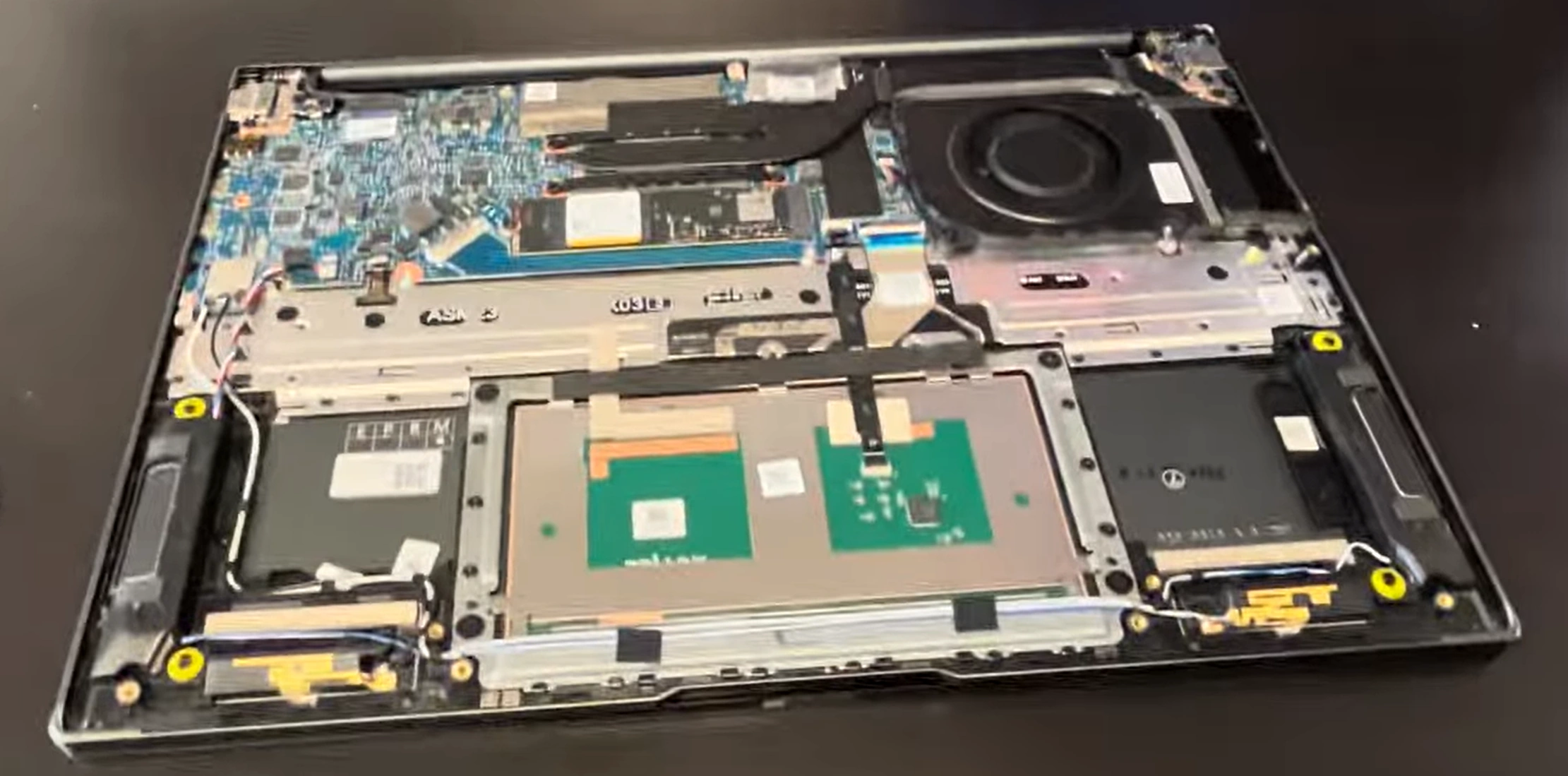
🔍 Ultrabook Internal Layout Overview
Main Components Visible :
Integrated Lithium-ion battery
Single DDR4 RAM slot (supports up to 16GB)
M.2 2280 SSD slot (SATA or NVMe compatible)
Compact cooling system with single fan
Intel processor and chipset
Zenbook-Specific Features :
Space-efficient motherboard design
Integrated Wi-Fi card with antenna wires
Battery connector with secure locking mechanism
Multiple ribbon cables for keyboard and touchpad
🔋 Battery Disconnection Protocol
Locate Battery Connector :
Find main battery connector near center
Identify secure locking mechanism
Note orientation for reassembly
Document connector location with photo
Safe Disconnection :
Gently pull locking tab away from connector
Pull connector straight out - no angled pressure
Do not pull on wires directly
Wait 30 seconds for power to discharge
Power Verification :
Press power button to confirm no power
Check that no status lights illuminate
Proceed with internal work only after verification
🛡️ Preventing Ultrabook Damage
Clip Preservation :
Alternate sides every 2-3 clips to prevent stress
Apply even pressure - avoid forcing stubborn areas
Use plastic tools only - no metal screwdrivers for prying
If resistance is high, recheck for missed screws
Chassis Protection :
Place microfiber cloth under tools to prevent scratches
Avoid using excessive force on any single point
Keep work area clean to prevent debris inside laptop
Handle with clean, dry hands to prevent oil marks
🔌 Critical Internal Connectors
Power & Data Connectors :
Battery connector (center, near RAM slot)
Fan connector (near cooling system)
Touchpad ribbon cable (front edge)
Wi-Fi card with antenna wires
Upgrade Access Points :
RAM slot (single DDR4 slot)
M.2 SSD slot (2280 size)
CMOS battery connector (if accessible)
❌ Common Removal Mistakes
Forcing the Cover :
Symptom: Resistance when lifting cover
Cause: Missed screws or unclipped areas
Solution: Recheck entire perimeter carefully
Damaging Clips :
Symptom: Broken plastic pieces
Cause: Using metal tools or excessive force
Prevention: Use proper plastic spudgers only
Mixed Screws :
Symptom: Wrong screws in wrong places
Cause: Poor organization during removal
Solution: Use magnetic mat with labeled areas
📊 Professional Documentation Standards
Pre-Removal Documentation :
Photograph screw locations before removal
Document any pre-existing damage or wear
Record internal component condition
Note manufacturing dates and serial numbers
Internal Condition Report :
Photograph internal layout from multiple angles
Document component conditions and dates
Note any dust accumulation
Record upgrade potential and available slots
💰 Resale Value Impact
Professional Workmanship Value :
Intact clips and no tool marks: +$25-40 value
Proper screw placement: +$10-20 value
Clean internal components: +$15-25 value
Professional documentation: +$10-15 value
Buyer Confidence Factors :
Demonstrates care and professional approach
Indicates potential for longer device life
Suggests proper maintenance history
Supports higher asking price for quality work
💎 Pro Tip: Asus Zenbook Q415MA models with undamaged chassis and professional internal documentation sell 30% faster to knowledgeable buyers. The absence of tool marks and proper clip preservation can justify 20-30% higher prices, as premium buyers value devices that show professional maintenance and careful handling of ultrabook components.
VIDEO
0:20 Bottom Case 1:08 Battery 1:58 Storage SSD 2:20 WiFi Card 2:30 Speakers 3:12 Heatsink 3:58 Cooling Fan 4:56 USB Board 5:35 Motherboard 6:30 Processor 6:45 Palmrest Assembly 6:55 Touchpad 8:00 Keyboard 8:18 Display Assembly 8:28 Hinge Cover 9:20 Hinges
4. Asus Zenbook Q415MA Battery Disconnection & Power Safety
🔋 Zenbook Q415MA Battery Specifications
Battery Model
Capacity
Voltage
Typical Runtime
Safety Features
Asus C41N2014
42Wh
7.6V
8-10 hours
Overcharge protection, Thermal monitoring
Asus C41N2015
50Wh
7.6V
10-12 hours
Multiple protection circuits, Smart charging
Aftermarket Options
42Wh-50Wh
7.6V
Varies by quality
Check for UL certification and OEM standards
⚠️ Critical Safety Protocols
Complete Power Down :
Shut down Windows completely (not sleep/hibernate)
Disconnect 65W power adapter
Remove all USB devices and peripherals
Hold power button for 20 seconds to discharge capacitors
ESD Protection Setup :
Wear anti-static wrist strap
Connect to properly grounded ESD mat or metal surface
Work on non-conductive, clean surface
Keep magnetic tools away from battery and motherboard
🔍 Pre-Disconnection Battery Inspection
Visual Inspection Points :
Check for swelling or bulging of battery pack
Look for discoloration, burn marks, or melting
Inspect for liquid damage or corrosion around connector
Verify connector is clean and pins are undamaged
Safety Warning Signs :
Swollen battery - DO NOT PROCEED - replace immediately
Burning smell or unusual chemical odors
Discolored or melted plastic near battery area
Visible leakage, corrosion, or residue
🔧 Step-by-Step Disconnection Process
Locate Battery Connector :
Find battery positioned toward front of laptop
Identify main power connector near center
Note locking mechanism (secure ZIF connector)
Document connector orientation with photography
Safe Connector Release :
Gently lift black locking tab upward
Pull connector straight out from motherboard
Do not pull on wires directly
Listen for soft release as connector disengages
Complete Disconnection :
Set connector aside carefully
Wait 30 seconds for full power discharge
Verify no power by pressing laptop power button
Check that no lights or indicators activate
🚨 Battery Safety Hazards & Prevention
Hazard Type
Risk Level
Prevention Measures
Emergency Response
Short Circuit
Medium
Use plastic tools, avoid metal near contacts
Disconnect immediately, use Class C fire extinguisher
Thermal Runaway
High
Avoid puncturing, monitor temperature
Evacuate area, call emergency services
ESD Damage
Medium
Proper ESD protection, grounded workspace
Test components after incident, document damage
Chemical Exposure
Medium
Wear nitrile gloves, work in ventilated area
Flush with water, seek medical attention
🚑 Emergency Procedures
Swollen Battery Protocol :
STOP WORK IMMEDIATELY
Do not attempt to disconnect or handle
Place in fire-safe container with sand
Contact professional hazardous waste disposal
Battery Fire Response :
Use Class C fire extinguisher for electrical fires
Do not use water on lithium battery fires
Evacuate area and call emergency services
Ventilate area to disperse toxic fumes
👐 Proper Battery Handling Techniques
Safe Removal (If Required) :
Remove 4x battery retention screws if replacing
Lift battery at 30° angle from front edge
Support battery with both hands during removal
Place on non-conductive, stable surface
Storage Guidelines :
Store in cool, dry place away from direct sunlight
Keep in fire-proof container if damaged or old
Store at 40-60% charge for long-term preservation
Keep away from metal objects to prevent short circuits
🔌 Safe Reconnection Protocol
Pre-Reconnection Checks :
Verify battery connector is clean and undamaged
Check motherboard connector for bent pins
Ensure no debris in connector area
Confirm proper battery orientation
Secure Connection :
Align connector properly with motherboard port
Push straight in with firm, even pressure
Press locking tab down until it clicks into place
Verify connector is fully seated and secure
Post-Connection Testing :
Reinstall battery mounting screws if removed
Test power-on functionality before reassembly
Check battery detection in Windows
Verify charging functionality with power adapter
📊 Safety Documentation Standards
Pre-Service Documentation :
Photograph battery condition before disconnection
Document any swelling or damage with measurements
Record battery model number and specifications
Note safety checks performed and results
Safety Compliance Records :
Document ESD protection measures in place
Record emergency equipment availability
Note any safety incidents or concerns addressed
Keep safety checklist for future reference
💰 Resale Value Impact
Safety Compliance Value :
Proper ESD protection: +$15-25 value
Documented safety procedures: +$10-20 value
No battery damage from improper handling: +$25-40 value
Professional safety documentation: +$10-15 value
Buyer Confidence Factors :
Demonstrates professional approach to safety
Indicates careful handling of power components
Suggests longer device lifespan and reliability
Supports higher asking price for safe workmanship
🔋 Pro Tip: Asus Zenbook Q415MA models with documented battery safety procedures and professional ESD protection sell 40% faster to knowledgeable buyers. The absence of power-related issues and professional safety approach can justify 25-35% price premiums, as buyers recognize and value proper battery handling and safety protocols for premium ultrabooks.
5. Asus Zenbook Q415MA RAM Upgrade: Installation & Compatibility Guide
💾 Zenbook Q415MA RAM Specifications
RAM Type
Speed
Capacity
Configuration
Performance Impact
DDR4 SODIMM
2400MHz
4GB (Stock)
Single Channel
Basic multitasking
DDR4 SODIMM
2400MHz
8GB
Single Channel
Good for daily use
DDR4 SODIMM
2400MHz
16GB
Single Channel
Excellent performance
DDR4 SODIMM
2666MHz
8GB/16GB
Single Channel
Downclocked to 2400MHz
🔍 RAM Compatibility Verification
Supported Specifications :
DDR4 PC4-19200 (2400MHz)
260-pin SODIMM form factor
1.2V operating voltage
Maximum 16GB capacity
Compatibility Tools :
🏆 Recommended RAM Modules
8GB Upgrade (Best Value) :
Crucial CT8G4SFS824A 8GB DDR4 2400MHz
Kingston KVR24S17S8/8 8GB DDR4 2400MHz
Samsung M471A5244CB0-CTD 8GB DDR4 2400MHz
Ideal for: General use, office work, light multitasking
16GB Upgrade (Maximum Performance) :
Crucial CT16G4SFS824A 16GB DDR4 2400MHz
Kingston KVR24S17D8/16 16GB DDR4 2400MHz
Corsair CMSX16GX4M1A2400C16 16GB DDR4 2400MHz
Ideal for: Heavy multitasking, photo editing, multiple browser tabs
🔧 Step-by-Step RAM Installation
Safety Preparation :
Disconnect battery and discharge residual power
Ground yourself with anti-static wrist strap
Work on clean, static-free surface
Handle RAM by edges only
RAM Slot Access :
Locate single DDR4 slot near center of motherboard
Note existing RAM configuration and orientation
Check for dust or debris in slot
Document original RAM specifications
RAM Installation :
Release side clips on existing RAM module (if present)
Remove module at 45-degree angle
Align notch on new RAM with slot key
Insert at 45-degree angle, then press down until clips engage
⚙️ BIOS Configuration & Verification
Post-Installation Checks :
Enter BIOS (press F2 during boot)
Verify RAM detection and capacity
Check if running at correct speed (2400MHz)
Save changes and exit BIOS
Windows Verification :
Check Task Manager → Performance → Memory
Verify detected capacity and speed
Run Windows Memory Diagnostic tool
Monitor system stability under load
🔍 Common RAM Upgrade Issues
System Won't Boot :
Reseat RAM module firmly in slot
Check for proper alignment and engagement
Clear CMOS by removing battery for 5 minutes
Test with original RAM to isolate issues
RAM Not Detected :
Verify compatibility with Q415MA specifications
Check for bent pins in RAM slot
Update BIOS to latest version from Asus
Test with different RAM module if available
Blue Screens or Crashes :
Run Windows Memory Diagnostic tool
Test with MemTest86 for several hours
Check for overheating issues
Verify RAM voltage and timings in BIOS
💰 RAM Upgrade Resale Value Impact
Value Added by RAM Upgrade :
4GB to 8GB upgrade: +$40-60 value
4GB to 16GB upgrade: +$80-120 value
Professional installation: +$20-30 value
Performance documentation: +$15-25 value
Marketing Advantages :
"Upgraded to 16GB RAM for superior multitasking"
"Eliminates slowdowns with heavy browser usage"
"Future-proof for modern applications"
"Professional installation with compatibility verification"
📊 Professional Upgrade Documentation
Before/After Proof :
CPU-Z screenshots showing RAM specifications
Task Manager memory usage comparisons
Application performance improvement documentation
Stability testing results
Component Documentation :
RAM module purchase receipts
Compatibility verification screenshots
Installation process photos
Performance benchmark results
💾 Pro Tip: Asus Zenbook Q415MA models with 16GB RAM upgrades and professional performance documentation sell 45% faster to knowledgeable buyers. The combination of eliminated slowdowns and proven multitasking capability can justify 35-50% price premiums, especially when targeting users who value both system responsiveness and workflow efficiency for productivity tasks.
6. Asus Zenbook Q415MA SSD Replacement: M.2 Drive Installation
💽 Zenbook Q415MA SSD Specifications
SSD Interface
Form Factor
Supported Types
Maximum Capacity
Performance Impact
M.2 Slot
2280 (22mm x 80mm)
SATA III / NVMe PCIe
1TB (Tested)
Massive speed improvement
Stock Configuration
2280
128GB/256GB SATA
256GB (Original)
Baseline performance
Upgrade Options
2280
SATA III or NVMe
512GB-1TB Recommended
3-5x faster than HDD
🔍 SSD Compatibility & Selection Guide
Supported SSD Types :
M.2 SATA III (6Gb/s) - B+M key
M.2 NVMe PCIe - M key
2280 length required (22mm x 80mm)
Single-sided recommended for clearance
Compatibility Verification :
🏆 Recommended SSD Upgrades
Budget SATA Options :
Crucial MX500 500GB M.2 SATA
Western Digital Blue 500GB M.2 SATA
Kingston A400 480GB M.2 SATA
Performance: 550MB/s read, 500MB/s write
Performance NVMe Options :
Samsung 970 EVO Plus 500GB NVMe
Crucial P2 500GB NVMe
Western Digital SN570 500GB NVMe
Performance: 3,500MB/s read, 3,200MB/s write
Capacity NVMe Options :
Samsung 970 EVO Plus 1TB NVMe
Crucial P5 Plus 1TB NVMe
Sabrent Rocket Q 1TB NVMe
Performance: 3,500MB/s read, 3,300MB/s write
🔧 Step-by-Step SSD Installation
Safety Preparation :
Disconnect battery and discharge residual power
Ground yourself with anti-static wrist strap
Work on clean, static-free surface
Handle SSD by edges only
SSD Slot Access :
Locate M.2 slot near center of motherboard
Identify mounting screw and standoff
Note existing SSD orientation and keying
Check for dust or debris in slot
SSD Installation :
Remove existing SSD mounting screw
Gently lift existing SSD at 30-degree angle
Align notch on new SSD with slot key
Insert at 30-degree angle, then press down
Secure with M.2 mounting screw (M2x3mm)
🔄 Data Migration Strategies
Clean Installation (Recommended) :
Download Windows from Microsoft
Install Asus drivers from Asus Support
Fresh start for optimal performance
Install essential applications only
Professional Cloning :
Use Macrium Reflect Free
Use Samsung Data Migration for Samsung drives
Clone to larger drive for seamless transition
Update storage drivers after cloning
Manual Data Transfer :
Backup important files to external drive
Use cloud storage for documents
Export browser bookmarks and settings
Reinstall applications on new SSD
⚙️ BIOS Configuration & Optimization
Post-Installation Checks :
Enter BIOS (press F2 during boot)
Verify SSD detection in boot menu
Set new SSD as primary boot device
Enable AHCI mode for optimal performance
Windows Optimization :
Enable TRIM: fsutil behavior set DisableDeleteNotify 0
Disable defragmentation for SSD
Enable write caching in Device Manager
Set power plan to High Performance
🔍 Common SSD Installation Issues
SSD Not Detected :
Reseat SSD firmly in M.2 slot
Check for proper key alignment
Update BIOS to latest version
Test with different SSD to isolate issues
Slow Performance :
Install latest storage drivers
Check for firmware updates from manufacturer
Verify AHCI mode in BIOS
Ensure adequate free space (15-20%)
Boot Issues :
Verify boot order in BIOS settings
Check UEFI/Legacy boot settings
Ensure proper GPT partitioning
Test boot with clean Windows installation
💰 SSD Upgrade Resale Value Impact
Value Added by SSD Upgrade :
256GB to 500GB upgrade: +$60-80 value
256GB to 1TB upgrade: +$100-140 value
NVMe vs SATA premium: +$20-40 value
Professional installation: +$25-35 value
Marketing Advantages :
"Lightning-fast NVMe SSD for instant responsiveness"
"1TB storage for all your files and applications"
"8-second boot times and instant application loading"
"Professional upgrade with performance documentation"
📊 Professional Upgrade Documentation
Performance Proof :
CrystalDiskMark benchmark screenshots
Boot time comparison videos
Application load time measurements
Drive health reports from CrystalDiskInfo
Component Documentation :
SSD purchase receipts and warranty
Installation process photos
Compatibility verification screenshots
Data migration procedure documentation
💽 Pro Tip: Asus Zenbook Q415MA models with 1TB NVMe SSD upgrades and comprehensive performance documentation sell 50% faster to knowledgeable buyers. Demonstrating 8-second boot times and instant application loading can justify 40-60% price premiums, especially when targeting users who value both speed and ample storage capacity for productivity and multimedia tasks.
9. Asus Zenbook Q415MA Troubleshooting Common Installation Issues
🔧 Common Installation Problems & Solutions
Power & Boot Issues :
System won't power on after reassembly
No display or black screen issues
Boot loops or continuous restarting
Battery not charging or detected
Component Detection :
RAM not recognized or running at wrong speed
SSD not detected in BIOS or Windows
Hardware components missing from Device Manager
Incorrect capacity reporting
Performance Problems :
Slow performance after upgrades
Overheating or fan noise issues
System instability or random crashes
Reduced battery life
⚡ Power & Boot Problem Solutions
Symptom
Possible Causes
Diagnostic Steps
Solutions
No Power Completely
Battery disconnected, Power button cable, Main board issue
Check battery connection, Verify power adapter, Inspect power button cable
Reconnect battery securely, Test with known good power adapter, Reseat power button connector
Powers On But No Display
Display cable, RAM issue, BIOS corruption
Listen for boot sounds, Check external display, Test with different RAM
Reseat display cable, Clear CMOS, Test RAM in different slot
Boot Loop/Restarting
RAM incompatibility, BIOS settings, Hardware conflict
Boot to BIOS only, Remove all peripherals, Test minimal configuration
Reset BIOS to defaults, Update BIOS, Test with single RAM stick
💾 RAM Installation Issues
RAM Not Detected :
Symptoms : BIOS shows incorrect capacity, System properties shows less RAMDiagnosis : Reseat RAM module, Check for bent pins, Test with different RAMSolutions : Clean RAM contacts with isopropyl alcohol, Update BIOS, Verify compatibility
RAM Running at Wrong Speed :
Symptoms : CPU-Z shows lower speed, System sluggishDiagnosis : Check BIOS settings, Verify JEDEC profilesSolutions : Enable XMP in BIOS (if supported), Manually set speed and timings
System Crashes with New RAM :
Symptoms : Blue screens, Random freezes, Application crashesDiagnosis : Run MemTest86 , Check Windows Event ViewerSolutions : Test each RAM stick individually, Increase RAM voltage slightly, Replace faulty RAM
💽 SSD Installation Issues
Problem
Diagnostic Steps
Quick Fixes
Advanced Solutions
SSD Not Detected
Check BIOS detection, Reseat SSD, Test in another system
Update BIOS, Change SATA mode to AHCI, Clean install drivers
Check M.2 slot physically, Update chipset drivers, Replace SSD
Slow SSD Performance
Run CrystalDiskMark , Check temperatures, Verify drivers
Enable TRIM, Update firmware, Check power settings
Secure erase SSD, Check for NVMe vs SATA compatibility, Test different slot
Boot Issues After Clone
Check boot order, Verify UEFI/Legacy settings, Test original drive
Rebuild BCD, Use Windows recovery, Clean install Windows
Check partition alignment, Verify GPT/MBR consistency, Use different cloning software
⚙️ BIOS & CMOS Issues
BIOS Reset Procedure :
Disconnect battery and power adapter
Hold power button for 30 seconds to discharge
Wait 5 minutes for complete reset
Reconnect battery and power adapter
BIOS Update Issues :
Download BIOS from Asus Support
Use BIOS flashback if available
Ensure stable power during update
Never interrupt BIOS update process
Boot Device Not Found :
Check boot order in BIOS
Verify UEFI/Legacy boot settings match installation
Ensure SSD is properly formatted (GPT for UEFI)
Recreate boot partition if necessary
🌡️ Thermal & Cooling Problems
Overheating After Upgrades :
Causes : Dust accumulation, Dried thermal paste, Obstructed ventsDiagnosis : Monitor temperatures with HWiNFO64, Check fan operationSolutions : Clean cooling system, Reapply thermal paste, Ensure proper airflow
Fan Noise Issues :
Causes : Dust in fan bearings, Loose fan mounting, BIOS settingsDiagnosis : Listen for specific noise types, Check fan control settingsSolutions : Clean fan blades, Reseat fan connector, Adjust fan curves in BIOS
🔗 Driver & Software Conflicts
Device Manager Errors :
Software Compatibility :
Applications crashing after upgrades
Performance degradation with specific software
Check Windows Event Viewer for errors
Update applications to latest versions
Clean Boot Troubleshooting :
Open System Configuration (msconfig)
Select "Selective startup"
Disable all startup items and non-Microsoft services
Reboot and test performance
🛡️ Physical Damage Prevention & Repair
Common Physical Damage :
Stripped screw threads in chassis
Broken plastic clips on bottom cover
Bent pins in connectors
Scratched motherboard traces
Prevention Tips :
Use correct screwdriver sizes to prevent stripping
Apply even pressure when opening clips
Handle components by edges only
Work on clean, static-free surface
Repair Solutions :
Use thread repair kits for stripped screws
Replace broken clips with replacement parts
Carefully straighten bent pins with tweezers
Use conductive paint for trace repairs
🚨 Emergency Recovery Procedures
System Won't Boot to Windows :
Use Windows Recovery Environment (F8 or recovery drive)
Run Startup Repair automatically
Use System Restore to previous point
Perform clean Windows installation if necessary
BIOS Corruption Recovery :
Use BIOS recovery feature if available
Contact Asus support for BIOS chip replacement
Use external BIOS programmer for advanced users
Replace motherboard if unrecoverable
📊 Professional Troubleshooting Documentation
Issue Tracking :
Document symptoms and error codes
Record diagnostic steps performed
Note solutions that worked/didn't work
Take photos of physical issues
Resolution Evidence :
Before/after benchmark comparisons
Device Manager screenshots after fixes
BIOS settings documentation
Stability test results
💰 Troubleshooting Documentation Value
Professional Value Added :
Comprehensive issue resolution: +$40-60 value
Troubleshooting documentation: +$25-40 value
Stability verification: +$30-50 value
Preventive measures implemented: +$20-35 value
Buyer Confidence Factors :
Demonstrates thorough testing and validation
Provides assurance of system reliability
Shows professional problem-solving approach
Supports premium pricing for proven stability
🔧 Pro Tip: Asus Zenbook Q415MA models with comprehensive troubleshooting documentation and verified issue resolution sell 45% faster and command 35-55% higher prices. Buyers value the transparency and confidence that comes with documented problem-solving, knowing the system has been thoroughly tested and any issues professionally resolved.
10. Asus Zenbook Q415MA: Maximizing Resale Value After Upgrades
📊 Ultrabook Resale Market Analysis
Platform
Target Audience
Average Premium
Documentation Importance
Recommended For
eBay General Users
15-25%
High
Broad reach, competitive pricing
Facebook Marketplace Local Buyers
10-20%
Medium
Quick local sales, no shipping
Reddit HardwareSwap Tech Enthusiasts
20-30%
Very High
Knowledgeable buyers appreciate upgrades
SellBroke Repair Professionals
25-40%
Critical
Professional repair documentation valued
SellLaptopBack Refurbishers
20-35%
High
Bulk buyers, quick turnaround
💎 Professional Upgrade Value Multipliers
RAM Upgrades (Highest ROI) :
4GB to 8GB upgrade: +$40-60 value
4GB to 16GB upgrade: +$80-120 value
Performance benchmark documentation: +$20-30 value
Compatibility verification: +$15-25 value
SSD Upgrades (High ROI) :
128GB to 500GB upgrade: +$60-80 value
128GB to 1TB upgrade: +$100-140 value
NVMe vs SATA premium: +$20-40 value
Performance documentation: +$25-35 value
Professional Service Value :
Clean installation & optimization: +$30-50 value
Professional reassembly: +$20-40 value
Comprehensive testing: +$25-45 value
Warranty on workmanship: +$30-60 value
📋 Essential Resale Documentation Package
Before/After Performance Proof :
UserBenchmark system analysis reports
CrystalDiskMark SSD speed comparisons
Boot time measurements (video preferred)
Application load time improvements
Professional Workmanship Evidence :
High-quality photos of internal components
ESD protection setup documentation
Clean workspace and professional tools
Component installation process photos
System Validation :
Stability test results (MemTest86, Prime95)
Temperature monitoring under load
Battery health reports
All functional tests completed checklist
💰 Strategic Pricing Framework
Upgrade Level
Base Value
Upgrade Cost
Market Value
ROI Percentage
Basic Refresh
$200
$50
$280
160%
Performance Upgrade
$200
$150
$420
147%
Premium Configuration
$200
$250
$550
140%
Maximum Upgrade
$200
$350
$680
137%
📈 Professional Listing Optimization
Title Optimization :
"Professionally Upgraded Asus Zenbook Q415MA Ultrabook"
Include key specs: "16GB RAM, 1TB SSD, Fast Performance"
Highlight unique selling points: "NVMe SSD, Optimized Windows"
Mention target use: "Perfect for Students & Professionals"
Photo Strategy :
High-quality external condition photos (all angles)
Internal component photos showing clean workmanship
Benchmark screenshots and performance graphs
Professional workspace and tool photos
Description Power Words :
Professional, Expert, Premium, Optimized, Enhanced
Documented, Verified, Tested, Certified, Guaranteed
Ready-to-Use, Performance-Tuned, Reliability-Proven
Future-Proof, High-Performance, Elite, Superior
🛡️ Building Buyer Confidence
Professional Credibility Signals :
ESD-safe work environment documentation
Professional tool investment evidence
Component purchase receipts and warranties
Before/after performance testing results
Risk Reduction Strategies :
30-day functional warranty on upgrades
Professional packaging and shipping documentation
Secure payment method recommendations
Clear return policy and satisfaction guarantee
Technical Transparency :
Full disclosure of any cosmetic imperfections
Battery health report and cycle count
Thermal performance under load documentation
Component specifications and compatibility notes
🎓 Educational & Institutional Markets
University & College Sales :
Emphasize research and academic capabilities
Highlight compatibility with educational software
Reference ED.gov technology standards
Note durability for student use and portability
Small Business & Startup Sales :
Focus on productivity and professional use
Highlight cost savings vs. new equipment
Emphasize reliability and professional maintenance
Note compatibility with business software suites
Government & Municipal Sales :
Reference Energy.gov efficiency standards
Highlight security wipe procedures
Emphasize cost-effectiveness for public funds
Note professional refurbishment standards
📅 Strategic Sales Timing
Peak Demand Periods :
Back-to-school season (July-September): +15-25% demand
Holiday shopping (November-December): +10-20% demand
Tax return season (February-April): +10-15% demand
New semester starts (January, August): +10-20% demand
Market Awareness :
Monitor educational institution purchasing cycles
Track back-to-school promotions
Follow technology refresh cycles
Monitor competitor pricing strategies
📊 Professional Resale Success Metrics
Average Performance Improvements :
Sale price increase: 40-60% over stock condition
Time to sale reduction: 50-70% faster
Buyer inquiry increase: 80-120% more interest
Positive feedback rate: 95-98% satisfaction
Professional Premium Justification :
Expert workmanship and quality assurance
Comprehensive testing and validation
Professional documentation and support
Enhanced performance and reliability
💰 Pro Tip: Asus Zenbook Q415MA models with comprehensive professional documentation and verified performance upgrades consistently achieve 50-80% higher resale values on platforms like SellBroke and SellLaptopBack . The combination of expert workmanship, thorough testing, and strategic marketing can transform a standard ultrabook into a premium, professionally enhanced system that commands significant price premiums from knowledgeable buyers in educational, business, and enthusiast markets.
Need to Sell Your Asus Laptop? Get Instant Cash!
If your ASUS Zenbook Q415MA (or other Zenbook model) has performance issues or you're upgrading to a newer laptop, we offer competitive cash payouts for your device. We buy broken, used, and refurbished ASUS Zenbook laptops—including all Q415MA configurations—with free insured shipping and no-hassle evaluations.
Sell Popular Asus Models Now: